
Supporting family has become more central to financial planning in recent years amid rising inflation and cost of living pressures.
In fact, one in three UK adults are relying on a future inheritance to fund their retirement, according to Aviva research.
If you want to provide financial help to your children or grandchildren, one solution might be lifetime gifting: passing wealth from your estate to your beneficiaries while you are still alive. This allows your loved ones to receive valuable financial support and can also help you manage your tax planning more effectively.
If you are considering gifting your estate early, there are several pros and cons to be aware of before making a decision.
Pro: Gifting early can reduce your estate’s IHT bill
Inheritance Tax (IHT) is an important consideration when it comes to passing your estate on to your loved ones.
As per 2026/27 tax year rules, IHT is usually charged at 40% on the value of your estate that exceeds the nil-rate band, currently £325,000.
You might also qualify for the residence nil-rate band, which provides an additional £175,000 relief if you are passing on your main residence to a direct descendant.
For example, if you had an estate valued at £1 million and both nil-rate bands applied, your estate would pay an IHT charge of £200,000 on death. The larger your estate, the more IHT it will be liable for.
Gifting can help you lower the value of your estate while taking advantage of specific allowances and reliefs:
- Annual exemption: Gift up to £3,000 every tax year to one person or split the amount between multiple people.
- Small gift allowance: Gift up to £250 to as many people as you like every tax year. This cannot be used alongside the annual exemption.
- Wedding gifts: Gift £5,000 to your child on their wedding day, £2,500 to a grandchild or great-grandchild, and £1,000 to anyone else.
- Gifts from surplus income: You can also make regular gifts from your income provided doing so doesn’t negatively impact your standard of living.
These allowances are free from IHT. Used as part of a long-term strategy, you can significantly reduce the value of your estate and its IHT exposure, leaving more wealth for your loved ones.
Pensions are a tax wrapper that historically allowed wealth to pass to beneficiaries free from IHT. However, from April 2027, most unused pension wealth and death benefits will be included as part of the estate.
Con: Gifting amounts that exceed these gifting allowances can be risky
Outside of allowances, you can make gifts known as potentially exempt transfers (PETs).
PETs are free from IHT only if they pass HMRC’s seven-year rule, which stipulates that if a gift is made more than seven years before you die, it won’t incur an IHT charge.
Any gifts that are given within seven years of your death could be liable for IHT, payable on a sliding scale known as taper relief. This charges IHT based on how much time has elapsed between giving the gift and death. If it’s within three years, the full rate of IHT applies (40%). After three years, the rate reduces.
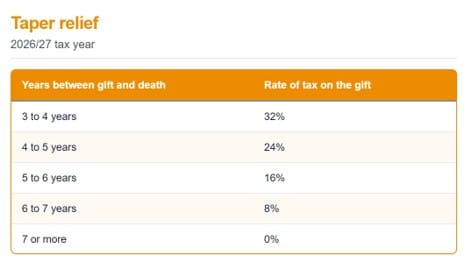
A PET can be an effective component of your gifting strategy, but there is a risk that your beneficiaries might receive an unexpected tax charge if you pass away within seven years of giving the gift.
Your loved ones may be required to pay this charge out of their own pocket, which could contribute to their financial stress.
Pro: You get to see the positive effect your wealth has
Gifting can make estate planning a more rewarding experience by allowing you to witness the positive impact your wealth has.
Rather than leaving wealth in your will, it can be put to use in the present to help solve financial problems your family might be facing, such as:
- Clearing debt
- Contributing towards a first-home deposit
- Paying school fees
- Buying a new car.
Gifting allows you to share in this joy first-hand. It also means you are there to guide your loved ones on how they can use their inheritance sensibly and effectively.
Con: Gifting too much can take away from your own financial freedom
Reducing your estate’s IHT bill is important for your family. But hyper-fixating on their needs can lead to “over-gifting”, by which you pass on wealth to the detriment of your current lifestyle.
Gifting too much means you have less to spend on yourself. You might be forced to compromise on your retirement goals, holidays, or dining out. It could also impact the level of care you can afford should you fall ill.
The right gifting strategy balances your needs with those of your loved ones, helping everyone achieve financial stability.
Your financial planner can help you discover your ideal gifting strategy.
Get in touch
Learn whether a gifting strategy is right for you by speaking to a member of our team today.
Please get in touch or email us at advice@mlifa.co.uk for more information.
Please note
This article is for general information only and does not constitute advice. The information is aimed at individuals only.
All information is correct at the time of writing and is subject to change in the future.
Remember that taper relief only applies to gifts in excess of the nil-rate band. It follows that, if no tax is payable on the transfer because it does not exceed the nil-rate band (after cumulation), there can be no relief.
Taper relief does not reduce the value transferred; it reduces the tax payable as a consequence of that transfer.
The Financial Conduct Authority does not regulate estate planning or tax planning.